
Corporate Restructuring Approvals
Corporate Restructuring Approvals
Corporate restructuring is a strategic step for companies seeking growth, efficiency, or financial stability. However, such restructuring—especially when it involves mergers, amalgamations, or capital reduction—requires statutory approvals and often scrutiny by regulatory authorities and stakeholders. Therefore, navigating the legal framework correctly is crucial to avoid delays, objections, or litigation.
At Prospect Legal, we assist companies at every stage of the restructuring process, from planning and documentation to approvals and dispute resolution before the appropriate forums.
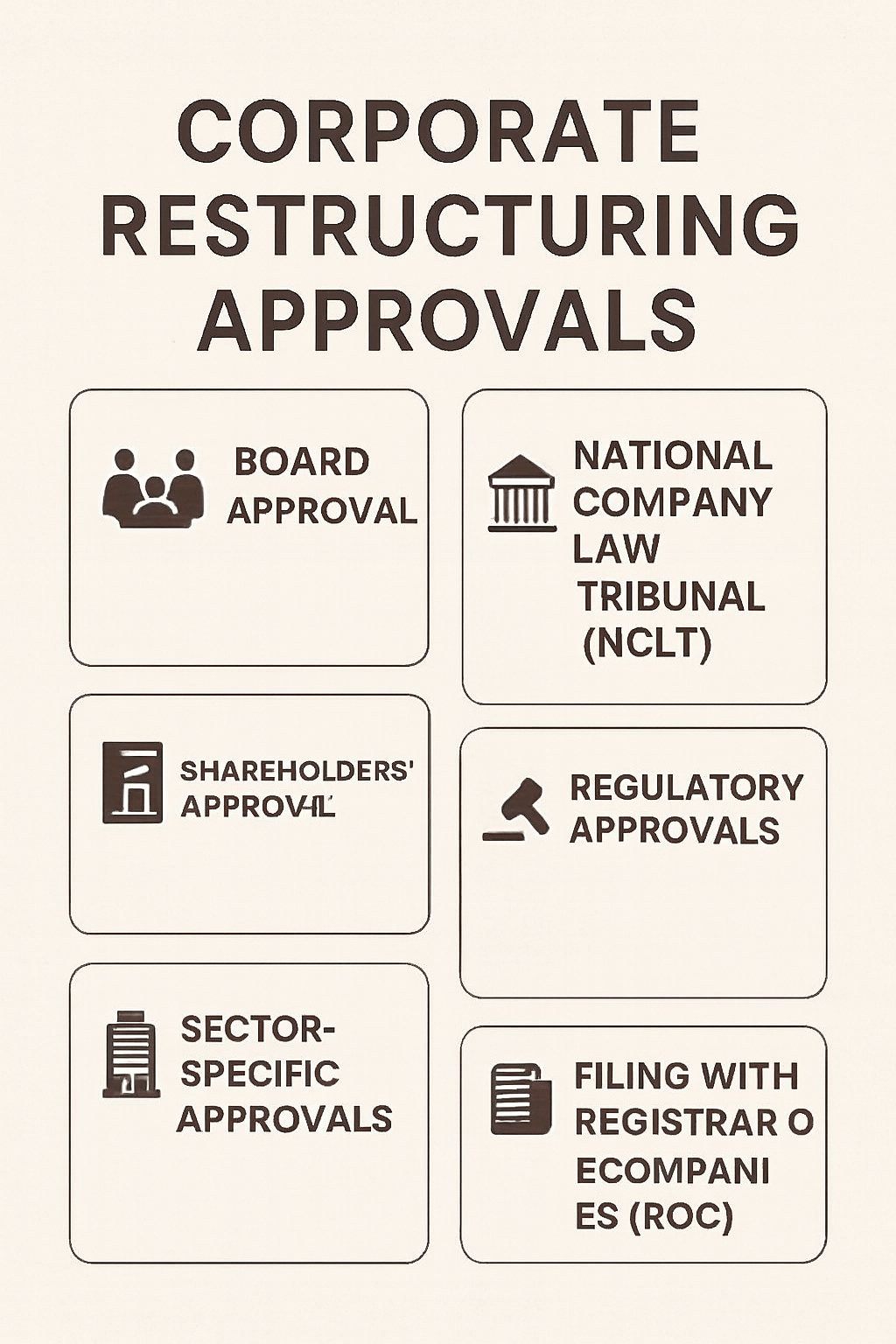
Corporate Restructuring Approvals
Corporate restructuring approvals are important when a company plans to reorganize its business, capital, or ownership to support long-term growth and stability. Since these changes affect shareholders, creditors, and regulators, getting the required statutory approvals is not only necessary but also helps ensure the process runs smoothly.
In many cases, especially where mergers, amalgamations, or capital reduction are involved, regulatory authorities closely review the restructuring process to check fairness and legal compliance. Therefore, companies must follow the prescribed procedures, prepare clear and accurate documents, and address stakeholder concerns at an early stage. Otherwise, even small mistakes or missing disclosures can result in objections, delays, or legal disputes. As a result, professional legal guidance becomes crucial to simplify approvals, reduce risks, and help companies complete restructuring efficiently and in full compliance with the law.

Mergers & Capital Reduction
Mergers, amalgamations, and capital reduction are among the most common forms of corporate restructuring. While these processes can unlock value and improve operational efficiency, they are also heavily regulated.
Mergers and Amalgamations
A merger or amalgamation involves the consolidation of two or more companies into a single entity. As a result, such schemes require approval from shareholders, creditors, and the National Company Law Tribunal (NCLT).
Key aspects include:
-
Drafting a legally compliant scheme of arrangement
-
Valuation reports and fairness opinions
-
Approvals from shareholders and creditors
-
Filing and representation before the NCLT
Capital Reduction
Capital reduction generally aims to reorganize a company’s capital structure. However, since it may affect creditor interests, it is closely examined by regulatory authorities.
Common objectives are:
-
Writing off accumulated losses
-
Returning surplus capital to shareholders
-
Aligning capital with current business realities
👉 You may also explore our detailed services on Company Law Litigation Services for ongoing regulatory support.
Category of Dispute – Mergers / Amalgamation
Disputes in mergers and amalgamations typically arise during the approval stage. Although the scheme may be commercially sound, objections from stakeholders can lead to prolonged litigation.
These disputes usually involve:
-
Shareholders opposing valuation or share-exchange ratios
-
Creditors raising concerns about repayment or security
-
Regulatory authorities questioning compliance or public interest
-
Minority shareholders alleging oppression or unfair treatment
Consequently, effective legal representation becomes essential to defend the scheme and address objections before the NCLT.
🔗 Related reading: Shareholder & Director Disputes before NCLT
Situations Leading to Litigation – Objections to Schemes
Despite careful planning, objections to restructuring schemes are common. In many cases, litigation arises due to lack of clarity, inadequate disclosures, or perceived prejudice to stakeholder interests.
Typical situations include:
-
Allegations that the scheme is unfair or unreasonable
-
Inadequate or improper valuation reports
-
Non-disclosure of material facts to shareholders or creditors
-
Procedural lapses in conducting meetings or obtaining approvals
-
Objections by statutory authorities on grounds of public policy
Nevertheless, with the right legal strategy, these issues can be effectively addressed and resolved.
Sections 230 & 232 of the Companies Act, 2013
Corporate restructuring through schemes of arrangement is primarily governed by Sections 230 and 232 of the Companies Act, 2013.
Section 230
This section deals with compromises and arrangements between a company and its members or creditors. It lays down:
-
The procedure for calling meetings
-
Disclosure requirements
-
Tribunal’s powers to approve or modify the scheme
Section 232
Section 232 specifically governs mergers and amalgamations, including:
-
Transfer of assets and liabilities
-
Dissolution of the transferor company without winding up
-
Issuance of shares or consideration by the transferee company
Because compliance with these provisions is mandatory, even minor lapses can invite objections or rejection of the scheme.


WHY CHOOSE PROSPECT LEGAL?
At Prospect Legal, we combine technical expertise with practical insight to deliver seamless restructuring solutions. Moreover, we focus on minimizing disputes and ensuring faster approvals.
Our strengths include:
-
End-to-end support in mergers, amalgamations, and capital reduction
-
Strategic handling of objections and litigation before NCLT
-
Clear communication with shareholders, creditors, and regulators
-
Strong focus on compliance, timelines, and risk mitigation
FREQUENTLY ASKED QUESTIONS
1. What types of company law cases can be filed before NCLT?
2. How do I file a company petition before NCLT Indore Bench?
3. Who can approach NCLT for shareholder or director disputes?
4. How long does an NCLT case usually take?
5. Do I need a lawyer to approach NCLT Indore?
CONTACT PROSPECT LEGAL FOR FURTHER ASSISTANCE
If your company is planning a merger, amalgamation, or capital reduction—or facing objections to a restructuring scheme—Prospect Legal is here to help.
📞 Contact us today to discuss your restructuring strategy and ensure smooth regulatory approvals.
📞 Phone: +91 7000127225
📧 Email: prospectlegalbpl@gmail.com
👉 Contact Prospect Legal today to schedule a consultation and take the first step toward protecting your rights.
Get Corporate Restructuring Approvals In Your City
We advise clients across Madhya Pradesh and all major Indian cities. Pick your city and our team calls you back — usually the same day.