
Privacy Violations & Data Breaches: Risks, Impact, and Prevention
What Is a Privacy Violation?
A privacy violation happens when personal or sensitive data is collected, accessed, shared, or used in ways that violate privacy laws, policies, or user consent.
Common Types of Privacy Violations
-
Unauthorized access to personal or medical records
-
Sharing data without user consent
-
Excessive data collection beyond intended purpose
-
Improper employee access to confidential information
-
Surveillance or tracking without disclosure
Examples of Sensitive Data
-
Personally Identifiable Information (PII)
-
Financial and banking details
-
Medical and health records
-
Login credentials and passwords
-
Biometric and location data
What Is a Data Breach?
A data breach occurs when protected information is exposed due to cyberattacks, system vulnerabilities, human error, or malicious insiders.
Common Causes of Data Breaches
-
Phishing and social engineering attacks
-
Weak or compromised passwords
-
Malware and ransomware attacks
-
Unpatched software vulnerabilities
-
Lost or stolen devices
-
Insider threats
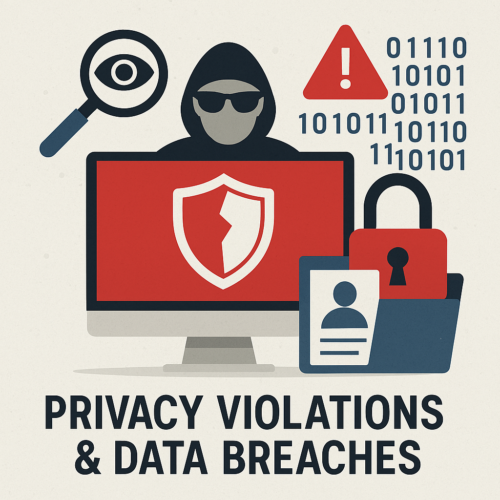
Privacy Violation vs Data Breach
Impact of Privacy Violations & Data Breaches:
Financial Impact
-
Direct financial losses
-
Fraud and identity theft
-
Regulatory fines and penalties
Legal & Compliance Risks
-
Violation of data protection laws
-
Lawsuits and compensation claims
-
Regulatory investigations
Reputational Damage
-
Loss of customer trust
-
Brand credibility damage
-
Reduced customer retention
Operational Disruption
-
System downtime
-
Incident response costs
-
Recovery and remediation expenses
How to Prevent Privacy Violations & Data Breaches
Best Practices for Individuals
-
Use strong and unique passwords
-
Enable multi-factor authentication (MFA)
-
Avoid sharing sensitive information on unsecured platforms
-
Be cautious of phishing emails and messages
-
Regularly update software and devices
Best Practices for Organizations
-
Implement data access controls and role-based permissions
-
Encrypt sensitive data at rest and in transit
-
Conduct regular security audits and vulnerability assessments
-
Train employees on data privacy and cybersecurity awareness
-
Establish clear data handling and retention policies
Frequently Asked Questions (FAQ)
1. What is a data breach?
A data breach occurs when unauthorized individuals gain access to sensitive, confidential, or protected information such as personal data, financial records, or login credentials, either through cyberattacks, system failures, or human error.
2. How is a data breach different from a privacy violation?
A data breach involves unauthorized access or exposure of data, usually due to security failures or attacks. A privacy violation happens when data is misused, shared, or collected without proper consent, even if no hacking occurs.
3. What types of data are most commonly affected in breaches?
Commonly affected data includes personally identifiable information (PII), passwords, financial details, health records, email addresses, and login credentials.
4. What should individuals do if their data is compromised?
Individuals should immediately change affected passwords, enable multi-factor authentication, monitor financial and online accounts for suspicious activity, and follow guidance provided by the organization involved in the breach.
5. How can organizations prevent future data breaches?
Organizations can reduce risks by implementing strong access controls, encrypting sensitive data, conducting regular security audits, training employees on cybersecurity awareness, and maintaining an effective incident response plan.
📩 Raise an Enquiry
Why Choose Prospect Legal Private Limited?
✔ Experienced Legal Team – Specialized in NGO related problems and streamlined process.
✔ End-to-End Assistance – From documentation to legal representation.
✔ Fast & Hassle-Free Process – Avoid unnecessary delays in your process.
✔ Affordable & Transparent Fees – No hidden charges, cost-effective solutions.
✔ Dedicated Support – Regular updates and expert legal guidance.
Contact Us
Address: R-52, First Floor, Zone 1, M.P. Nagar, Near Hotel Shree Vatika, Bhopal – 462011 (M.P.)
Call: 7000-12-7225
Email ID: prospectlegalbpl@gmail.com
Website: www.prospectlegal.co.in