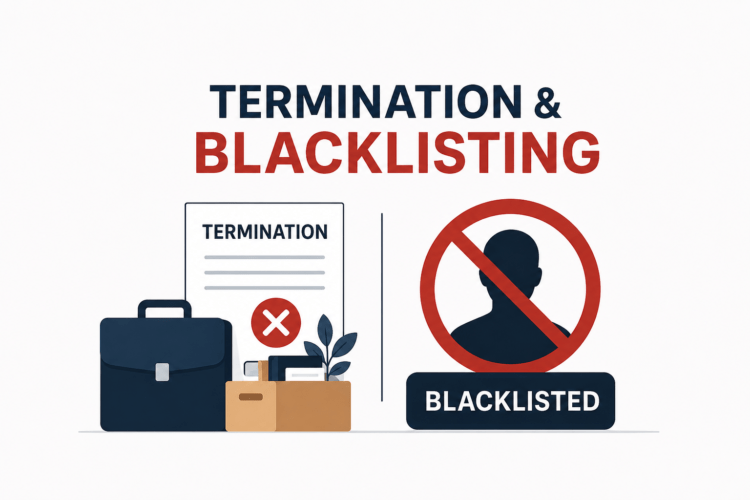
Termination and Blacklisting in MP PWD – PIU: Complete Guide for Contractors, Suppliers & Consultants
Receiving a termination notice or blacklisting order from the Madhya Pradesh Public Works Department (MP PWD) or its Project Implementation Unit (PIU) can have serious financial and legal consequences. Besides affecting the current contract, it may also prevent a contractor, supplier, consultant, or construction company from participating in future government tenders.
However, not every termination automatically leads to blacklisting, and not every blacklisting order is legally valid. Government authorities must follow prescribed procedures, comply with principles of natural justice, and provide the affected party with a fair opportunity to respond.
This guide explains the difference between contract termination and blacklisting in MP PWD–PIU, the applicable procedures, common reasons, legal remedies, and practical steps contractors should take to protect their business interests.
What is Termination in MP PWD – PIU?
Termination refers to the formal cancellation of a government contract before the completion of the agreed work. The department may terminate the contract when it believes that the contractor has failed to meet contractual obligations.
Termination ends the contractual relationship, but it does not automatically prohibit the contractor from participating in future government tenders.
Common Reasons for Contract Termination
The MP PWD–PIU may consider termination in situations such as:
- Delay in completing project milestones
- Abandonment of work without authorization
- Persistent poor quality of construction
- Failure to deploy required manpower or machinery
- Violation of contractual conditions
- Submission of incorrect or misleading information
- Financial incapacity affecting project execution
- Failure to comply with safety or statutory requirements
Each case should be evaluated based on the specific terms of the contract, correspondence between the parties, and available evidence.
What is Blacklisting?
Blacklisting is an administrative action through which a contractor or company is declared ineligible to participate in government procurement for a specified period.
Unlike termination, blacklisting affects future business opportunities across government departments and may significantly impact the reputation of the contractor.
Because of its serious consequences, blacklisting cannot ordinarily be imposed without following due process.
Difference Between Termination and Blacklisting
| Termination | Comparison Criteria | Blacklisting |
|---|---|---|
| Ends an existing contract before completion. | Purpose | Restricts participation in future government tenders for a specified period. |
| Primarily affects the current project under execution. | Scope | May affect eligibility across multiple government departments. |
| Based on contractual obligations and performance under the agreement. | Basis | Based on an administrative decision taken by the competent authority. |
| Does not automatically prohibit participation in future tenders. | Future Tender Eligibility | Can prohibit the contractor from bidding for government projects for a specified period. |
| May involve financial recovery, forfeiture of security deposit, or contractual claims. | Business Impact | Can cause long-term reputational damage, commercial losses, and reduced business opportunities. |
Why This Difference Matters
Understanding the distinction between termination and blacklisting is essential because the legal remedies, financial implications, and future business consequences may differ depending on the action taken by the MP PWD–PIU. While termination generally affects only the existing contract, blacklisting can significantly impact a contractor's ability to secure future government projects.
Can MP PWD–PIU Blacklist a Contractor?
Yes. The competent authority may blacklist a contractor where the facts, contractual record, and applicable procurement rules justify such action. However, blacklisting should generally follow a fair and transparent procedure.
The authority is generally expected to:
- Issue a detailed show cause notice.
- Clearly specify the allegations against the contractor.
- Provide reasonable time to submit a written reply.
- Consider the contractor's explanation objectively.
- Pass a reasoned and speaking order based on the available evidence.
- Clearly specify the duration and scope of the blacklisting order.
Failure to follow these procedural safeguards may make the blacklisting order vulnerable to legal challenge on the grounds of violation of the principles of natural justice.
What Should You Do After Receiving a Show Cause Notice?
The period immediately after receiving a show cause notice from MP PWD–PIU is critical. A timely and well-supported response can significantly influence the outcome of the proceedings. Contractors should carefully review the notice, gather relevant documents, prepare a detailed reply, and present their case effectively before the competent authority.
Read the Notice Carefully
Carefully review the show cause notice and identify the specific allegations, relevant contract clauses, the deadline for submitting your reply, and any documents or information requested by the department.
Collect Supporting Evidence
Gather all relevant project records, including site records, progress reports, measurement books, official correspondence, photographs, quality reports, extension requests, and payment records to support your explanation.
Prepare a Detailed Reply
Respond to every allegation separately, explain the factual circumstances, refer to the relevant contractual provisions, attach supporting documents, and clearly highlight delays or issues attributable to the department, wherever applicable.
Attend the Personal Hearing
If a personal hearing is offered, present your case clearly, answer the allegations with supporting evidence, and submit any additional documents that strengthen your defence.
Documents That Can Strengthen Your Defence
Contractors should maintain complete project documentation throughout the execution of the contract. Important records include:
- Letter of Acceptance (LOA)
- Agreement copy
- Work orders
- Running Account (RA) Bills
- Extension approvals
- Site instructions
- Progress reports
- Engineer correspondence
- Inspection reports
- Completion records
- Material testing reports
- Payment communications
Well-organized documentation strengthens your response and helps establish the factual position during departmental proceedings.
Consequences of Blacklisting
A blacklisting order may affect multiple aspects of your business.
Potential consequences include:
- Ineligibility for future government tenders
- Loss of ongoing business opportunities
- Reduced credibility with clients
- Financial losses
- Banking and financing difficulties
- Impact on consortium or joint venture participation
- Reputational damage
Therefore, timely legal and contractual action becomes extremely important.
Can a Blacklisting Order Be Challenged?
Yes.
Depending on the circumstances, a contractor may challenge the decision if:
- No proper notice was issued
- Opportunity of hearing was denied
- The order lacks reasons
- Principles of natural justice were violated
- The punishment is disproportionate
- The authority exceeded its powers
- Relevant evidence was ignored
The appropriate legal remedy depends on the facts of each case and the applicable contractual and statutory framework.
Best Practices to Avoid Termination and Blacklisting
Contractors can reduce project risks by adopting good compliance practices.
Before Bidding
- Study tender documents carefully.
- Verify eligibility requirements.
- Assess project capacity realistically.
- Understand timelines and technical specifications.
During Project Execution
- Maintain regular progress reports.
- Record all departmental communications.
- Seek written approvals for variations.
- Report delays immediately.
- Follow quality standards.
- Maintain statutory compliance.
- Preserve complete project documentation.
Before Project Completion
- Resolve pending issues promptly.
- Complete defect rectification.
- Obtain completion certificates.
- Preserve records for future reference.
These practices not only reduce disputes but also improve credibility in future procurement opportunities.
Common Mistakes Contractors Should Avoid
Many disputes arise because contractors overlook basic contractual responsibilities.
Some common mistakes include:
- Ignoring show cause notices
- Missing reply deadlines
- Submitting incomplete documentation
- Relying only on verbal communication
- Failing to request extensions in writing
- Not maintaining project records
- Using unsupported explanations
- Delaying legal advice after receiving adverse orders
Avoiding these mistakes can improve the chances of resolving disputes effectively.
Frequently Asked Questions (FAQs)
1. Does termination automatically lead to blacklisting in MP PWD–PIU?
2. Can a contractor be blacklisted without receiving a show cause notice?
3. How long can blacklisting remain effective?
4. What documents should be submitted while replying to a show cause notice?
5. Can delays caused by the department be used as a defence?
Conclusion
Termination and blacklisting under MP PWD–PIU can have far-reaching implications for contractors, suppliers, consultants, and infrastructure companies. While termination primarily affects an existing contract, blacklisting may restrict future participation in government procurement and significantly impact business reputation.
Understanding the applicable contractual obligations, responding promptly to notices, maintaining proper documentation, and ensuring procedural fairness are essential for protecting your rights. By following sound contract management practices and taking timely action when disputes arise, contractors can reduce risks and improve their ability to resolve issues effectively while continuing to participate in public infrastructure projects.