
Management Control Disputes
Management Control Disputes
Management control disputes arise when the lawful authority to run a company is challenged. In many cases, one group tries to take over control without following the law. As a result, decision-making suffers and the company’s future is put at risk. Therefore, timely legal action becomes important to protect ownership rights, board balance, and business continuity.
Contact us for Legal Help - +91 7000127225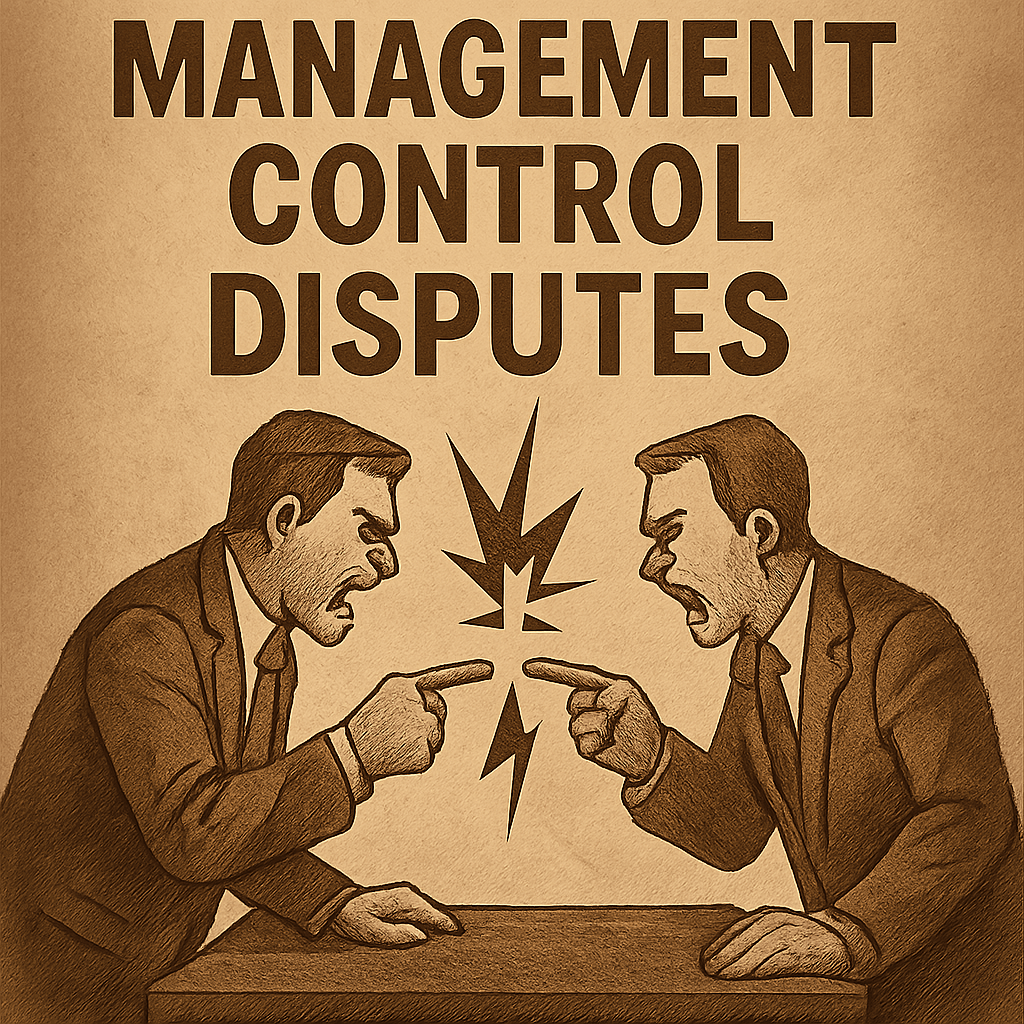
Management Control Disputes
Management control disputes occur when there is a conflict over who has the lawful authority to manage and control a company. These disputes often arise in closely held companies, family-run businesses, and joint ventures. Although differences may start at the board level, they usually escalate when one group attempts to illegally take over control, leaving no option but litigation before the National Company Law Tribunal (NCLT) under Section 242 of the Companies Act, 2013.
Such disputes are serious because they directly affect the company’s governance, finances, and daily operations. Moreover, when management decisions are taken without authority, the interests of shareholders, employees, and creditors are also affected. Therefore, understanding how these disputes arise and how the law responds is essential.
Common Causes of Management Control Disputes
Management control disputes usually arise due to a mix of legal violations and power struggles. Some common causes include:
-
Illegal transfer of shares to gain majority control
-
Removal or appointment of directors without following due process
-
Misuse of majority voting power at board or shareholder meetings
-
Breach of shareholder or joint venture agreements
-
Exclusion of promoters or minority shareholders from management
-
Manipulation of company records or statutory filings
As a result, trust breaks down, and internal resolution becomes impossible.
Tribunal Intervention

Category of Dispute – Control & Takeover
Management control disputes fall under control takeover disputes, where power shifts without legal backing. Often, this is done to gain dominance over assets or decisions.
Common patterns include:
-
Forced removal of promoters or directors
-
Sudden change in board composition
-
Misuse of majority voting power
-
Breach of shareholder agreements
Thus, these disputes directly impact governance and require immediate legal review.
Situations Leading to Litigation – Illegal Control of Takeover
Litigation usually starts when control is taken in an unfair or unlawful way. Initially, parties try internal resolution. However, when actions continue, legal steps become unavoidable.
Situations that trigger litigation:
-
Transfer of shares without proper approval
-
Oppression of minority shareholders
-
Denial of participation in management
-
Decisions taken without valid board authority
Therefore, Section 242 offers a structured remedy to stop such practices and protect stakeholders.
Section 242 of the Companies Act, 2013


Why Choose Prospect Legal for Management Control Disputes?
Choosing the right legal team makes a clear difference. Prospect Legal focuses on practical, result-driven solutions.
Why clients trust us:
-
Strong experience in NCLT control disputes
-
Clear advice without complex legal language
-
Strategic handling of urgent interim reliefs
-
End-to-end support from filing to final order
Moreover, we prioritize business stability while protecting your legal rights.
Frequently Asked Questions (FAQs)
1. What is a management control dispute?
2. When can Section 242 be used?
3. Can minority shareholders file a case?
4. What relief can NCLT grant?
5. How long do such cases take?
CONTACT PROSPECT LEGAL FOR FURTHER ASSISTANCE
If you are facing a management control or takeover dispute, early legal action matters. Prospect Legal is ready to help you regain lawful control and protect your company’s future.
Reach out today for clear guidance and confident legal representation.
📞 Phone: +91 7000127225
📧 Email: prospectlegalbpl@gmail.com
👉 Contact Prospect Legal today to schedule a consultation and take the first step toward protecting your rights.
Get Management Control Disputes In Your City
We advise clients across Madhya Pradesh and all major Indian cities. Pick your city and our team calls you back — usually the same day.